

 日本語
日本語  Deutsch
  English
  Español
  Français
  Português
Deep in the Sahelian scrubland of Niger, the dust rises in thick, suffocating clouds as the sun beats down with a ferocity that would break a lesser man. But for the men of the Wodaabe tribe—a nomadic subgroup of the Fulani—this isn't a day for survival. It is a day for conquest.
While the Western world often views masculinity through the lens of grit, stoicism, and rugged utility, the Wodaabe turn this concept on its head. Here, the ultimate expression of male dominance isn't found in the size of a man’s bicep or the depth of his pockets, but in the symmetry of his face, the whiteness of his teeth, and his ability to lure a woman away from her husband through nothing but the sheer magnetic force of his aesthetic performance.
Welcome to the Gerewol festival, the world’s most high-stakes beauty pageant, where the prize isn't a trophy—it’s another man’s wife.
The Aesthetics of Power
In the West, we are told that "looks don't matter" for men, yet we know instinctively that presence is a currency. The Wodaabe don't just acknowledge this; they weaponize it. To a Wodaabe man, beauty is a duty. It is an evolutionary signal of health, genetic superiority, and social standing.
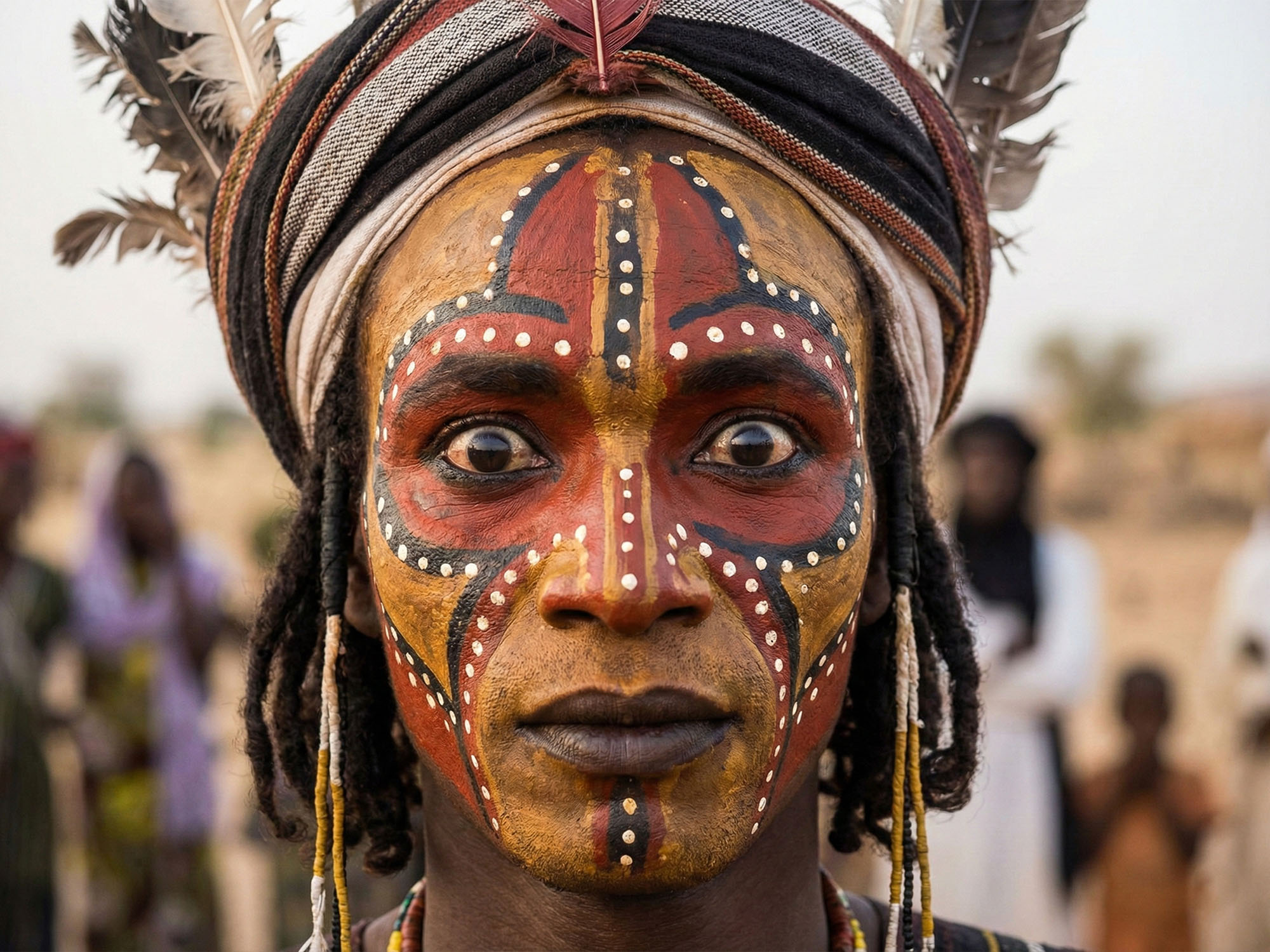
For weeks leading up to the Gerewol, men spend hours in front of small, handheld mirrors. They aren't looking for flaws to hide; they are painting a mask of perfection. Using red ochre, yellow clay, and black eyeliner derived from charred desert minerals, they highlight the features that signify Wodaabe "excellence":
-
A long, straight nose: A symbol of nobility.
-
Bright, white teeth: A sign of health and vitality.
-
Large, white eyes: Indicative of focus and intensity.
This isn't about vanity in the modern, narcissistic sense. It is about performance. In the wild, the peacock displays his feathers to prove he has the excess energy to spare—energy that isn't just going toward survival, but toward brilliance. The Wodaabe man is the desert’s peacock.
The Dance of the Yaake
When the sun begins to dip, the men line up shoulder-to-shoulder for the Yaake dance. This is no rhythmic shuffle. It is a grueling, hours-long endurance test where men stand on their tiptoes to appear taller, rolling their eyes and baring their teeth in a way that, to an outsider, looks bizarre or even frightening.
To the Wodaabe women watching from the sidelines, these facial contortions are a display of "Toggu"—the charm and magnetism that separates a leader from a follower. The men chant, their voices a hypnotic drone that mimics the low lowing of the Zebu cattle they herd. They are competing for the attention of three young women—often the daughters of past winners—who act as judges.
"In the Sahel, a man’s worth is measured by his cattle and his charisma. During the Gerewol, the cattle are forgotten. Only the man remains, stripped down to his ability to enchant."
The Ultimate Stakes: Stealing a Wife
Here is where the Gerewol takes a turn that would leave a modern divorce court in shambles. The Wodaabe recognize two types of marriage: Kobgal, an arranged marriage between cousins, and Teegal, a marriage of passion.
The Gerewol is the primary market for Teegal.
If a man performs well enough—if his eyes are white enough and his stamina great enough—a woman may choose him. It does not matter if she is already married. If she finds a performer more "beautiful" than her current husband, she can choose to be "stolen." This isn't a kidnapping; it’s a choice. The woman leaves her current domestic life to join the new man, often under the cover of night.
For the men, this is the ultimate validation of their masculinity. To "steal" a wife is to prove that your "Toggu" is superior to that of your rival. It is a raw, honest acknowledgment of female preference—one that bypasses social niceties and goes straight to the core of attraction.
In the harsh reality of the Sahel, beauty isn't a luxury—it’s a diagnostic tool. When a Wodaabe woman scans the line of dancing men, she isn't just looking for an attractive partner; she is assessing his biological "fitness" in the truest evolutionary sense. To the Wodaabe, a man’s face and body are a map of his health, his hormones, and his ability to provide stable genetics for the next generation.
Here are the specific biological markers of health that drive the Gerewol competition and why they matter from a performance perspective.
1. Ocular Clarity (The "White Eye" Metric)
One of the most striking sights during the Yaake dance is the men rolling their eyes, showing as much of the sclera (the white part of the eye) as possible.
-
The Biological Reality: In an environment plagued by dust, bacteria, and harsh UV rays, clear, bright whites are a sign of a robust immune system. Yellowing or bloodshot eyes can indicate jaundice, infection, or chronic dehydration.
-
The Performance Edge: By flashing their eyes, men are proving they have the internal "cleanliness" and hydration levels required to thrive in a desert climate.
2. Dental Symmetry and Enamel Health
A Wodaabe man will spend the entire dance baring his teeth in a fixed, wide grimace.
-
The Biological Reality: Teeth are a permanent record of a man’s nutritional history. Straight, white, and complete sets of teeth suggest that the man had access to high-quality nutrition (specifically calcium and fat-soluble vitamins from Zebu milk) during his developmental years.
-
The Performance Edge: Since the Wodaabe use natural "miswak" chewing sticks, the condition of the teeth also shows a man's discipline and attention to hygiene—traits necessary for the survival of a nomadic family.
3. Facial Symmetry and the "Straight Nose"
The Wodaabe prize a long, thin, symmetrical nose. While this is a cultural preference, it aligns with broader biological theories on symmetry.
- The Biological Reality: High facial symmetry is often linked to "developmental stability." It suggests that the man’s body successfully navigated the stresses of growth—parasites, pathogens, and malnutrition—without his DNA "glitching" or producing asymmetrical features.
- The Performance Edge: Symmetry is a universal signifier of genetic quality. In a world without modern medicine, a symmetrical face is a badge of high-functioning biological hardware.
4. Metabolic Leanness and Vitality
Unlike Western body standards that often prize bulky musculature, the Wodaabe value a tall, lean, and lithe frame.
-
The Biological Reality: Excessive muscle mass is "expensive" to maintain in a desert where calories are scarce. A lean, wiry frame indicates high metabolic efficiency and heat tolerance.
-
The Performance Edge: The endurance required to dance for hours under the sun is a test of the cardiovascular system. A man who can maintain a high-intensity performance without collapsing is signaling that his heart and lungs are in peak condition.
The "Toggu" Scorecard: A Biological Breakdown
To understand how these markers aggregate into a man's overall "rank," we can look at how they are weighted during the festival.
The Wodaabe Fitness Scorecard
| Marker | Observed Trait | Biological Meaning |
|---|---|---|
| Eyes | Wide, Rolling, White | Immune health & hydration |
| Teeth | Bared, White, Symmetrical | Nutritional history & hygiene |
| Stature | Tall, Tixtoe Standing | Dominance & genetic reach |
| Movement | Rhythmic, Fluid, Persistent | Neurological & muscular health |
The Hormone Factor: Testosterone and Composure
While the Wodaabe focus on beauty, the entire ritual is an undercover test of testosterone. High testosterone is associated with the confidence to perform in front of a crowd and the competitive drive to "steal" a wife.
However, the Wodaabe value controlled testosterone. A man who becomes aggressive or loses his temper during the dance fails the test of Pulaaku (their code of conduct). True masculinity, in their eyes, is the ability to project power and beauty while remaining completely in control of one’s emotions.
It is a sophisticated, ancient form of "Alpha" behavior: being the most visible and attractive man in the room without having to throw a single punch.
Quick-Start Box: Applying Wodaabe Discipline
Think the Wodaabe approach is just for the desert? Think again. Here is how you can apply their focus on performance markers to your own life.
The Wodaabe Performance Protocol
Do:
- Focus on Sclera Health: Prioritize sleep and hydration. If your eyes are consistently red or yellow, your internal health is lagging.
- Prioritize Dental Integrity: White teeth are a universal signal of health. It’s the highest ROI grooming habit you can have.
- Practice Stoic Presence: High-value men remain calm under pressure. Practice holding eye contact and maintaining a "ready" posture.
Don't:
- Confuse Bulk with Fitness: Function and endurance are the true markers of a capable man. Don't sacrifice agility for sheer size.
- Neglect Your 'Mask': Presentation is a tool. Whether it's a suit or a clean-shaven face, how you "paint" yourself for the world matters.
Survival of the Fittest
While the ritual may seem strange to those of us accustomed to monogamous stability, it serves a biological purpose. By prioritizing physical beauty and performance, the Wodaabe ensure that the strongest, healthiest, and most "magnetic" genes are passed forward. It is a meritocracy of the flesh.
Intelligence, in this context, isn't about solving equations; it’s about social intelligence. It’s the ability to read a crowd, to maintain composure under the grueling heat, and to project a sense of unwavering confidence. A man who flinches or loses his rhythm is dismissed. In the harsh environment of Niger, weakness—whether physical or social—is a death sentence for a lineage.
Performance and Pressure
For the men involved, the pressure is immense. Imagine standing in the heat, wearing several pounds of beads, leather, and ostrich feathers, while vibrating with the effort of keeping your eyes wide and your smile perfect for hours on end. There is no "off" switch.
This level of physical performance requires a high level of hormonal health and metabolic efficiency. The Wodaabe diet—heavy on milk and occasional meat—supports the lean, wiry frames necessary for this endurance. They do not value the bulk of a modern bodybuilder; they value the agility of a hunter.
In our world, we often separate "men's health" into buckets: gym time, work time, and dating. For the Wodaabe, these are one and the same. Your health is your work, and your work determines your success with women.
Why It Matters to Us
We might look at the blue face paint and the ostrich feathers and think the Wodaabe are a world away. But the core drivers are the same. Men everywhere are constantly being judged on their "performance"—whether it’s in a boardroom, on a first date, or in a gym.
The Wodaabe simply have the honesty to make the competition explicit. They acknowledge that women are the gatekeepers of reproduction and that a man’s job is to prove he is worthy of being chosen. It is a reminder that masculinity is not a static state, but a continuous performance that requires maintenance, effort, and a bit of bravado.
Comparison of Mating Rituals: Wodaabe vs. Western
The following table outlines the stark differences in how masculinity and attraction are handled between these two cultures.
Ritual Comparison Table
| Feature | Wodaabe Gerewol | Modern Western Dating |
|---|---|---|
| Primary Trait | Physical Beauty & Charm | Wealth & Social Status |
| Male Display | Makeup, Dance, Eyes/Teeth | Cars, Clothing, Digital Profiles |
| Selection Process | Direct female judging panels | Algorithmic swiping |
| Duration | 7 Days of intensive ritual | Ongoing/Indefinite |
Did You Know?
To achieve the terrifyingly wide-eyed look prized during the dance, Wodaabe men often ingest a cocktail of local desert herbs known for their stimulant properties. These plants can cause mydriasis (extreme pupil dilation) and provide the manic energy needed to dance for three days straight without sleep. It is a literal pharmacological "bio-hack" for attraction.
The Lessons of the Desert
What can the modern man take from the dust of Niger?
-
Own Your Presence: The Wodaabe don't apologize for their desire to be noticed. In a world that often tells men to "shrink" or be less aggressive in their self-presentation, there is power in standing tall and baring your teeth.
-
Health is the Foundation: The ability to dance for hours in 100-degree heat isn't just about "will." It’s about a body that works. Performance—in any arena—starts with biological integrity.
-
Competition is Natural: We are told that competition is "toxic." The Wodaabe show us that competition can be an art form. It drives men to be better, sharper, and more vibrant.
The Gerewol is a strange, bizarre, and shocking spectacle to the uninitiated. But strip away the feathers and the yellow clay, and you find a group of men doing exactly what men have done since the dawn of time: standing in a line, looking the world in the eye, and saying, "Look at me. I am the best choice."
Gerewol: Frequently Asked Questions
In Brief
The Wodaabe Gerewol festival is a masterclass in male performance. It challenges our Western notions of masculinity by proving that beauty and strength are not mutually exclusive. In the desert, the man who stands tallest and shines brightest takes the prize. It’s a primal, honest, and undeniably rugged look at what it means to compete for the things that matter most.