

 日本語
日本語  Deutsch
  English
  Español
  Français
  Português
Most men treat their genital anatomy like they treat their truck engines: as long as it starts when they turn the key and gets them where they need to go, they don't bother looking under the hood. We focus on performance and appearance, often ignoring the mechanics that make the whole system possible. But a man who doesn't understand his own hardware is a man operating at a disadvantage.
Society tends to treat male anatomy with either clinical coldness or locker-room jokes. There is rarely a middle ground that respects the sheer biological grit of the male form. This isn't about "wellness" trends or sensitive soul-searching. This is about knowing the specs of the machine you were born with.
From the hydraulic pressures that rival industrial equipment to the thermal regulation systems that keep your legacy alive, your anatomy is a marvel of evolution. It is built for action, for endurance, and for the continuation of your line. Here are ten facts about the male genital structure that you probably didn't learn in school, but definitely should have.
1. The Anchor: The Suspensory Ligament
When you look at your anatomy, you’re only seeing a portion of the total structure. A significant part of the male organ is internal, tucked behind the pubic bone. What keeps it all together and determines the "angle of attack" is the suspensory ligament.
This is a tough, fibrous band that attaches the base of the organ to the pubic symphysis. Think of it like the rigging on a ship. It holds the shaft in place and provides the structural support needed for physical activity. Some men, in a misguided attempt to gain length, undergo surgeries to cut this ligament. While this might make the organ appear longer when flaccid, it often results in a loss of stability. A man needs his foundation. Without this anchor, the mechanics of performance are compromised. It is the silent partner in your anatomy, providing the upward tilt that defines the male silhouette.
2. The Hydraulic Chambers: Corpora Cavernosa
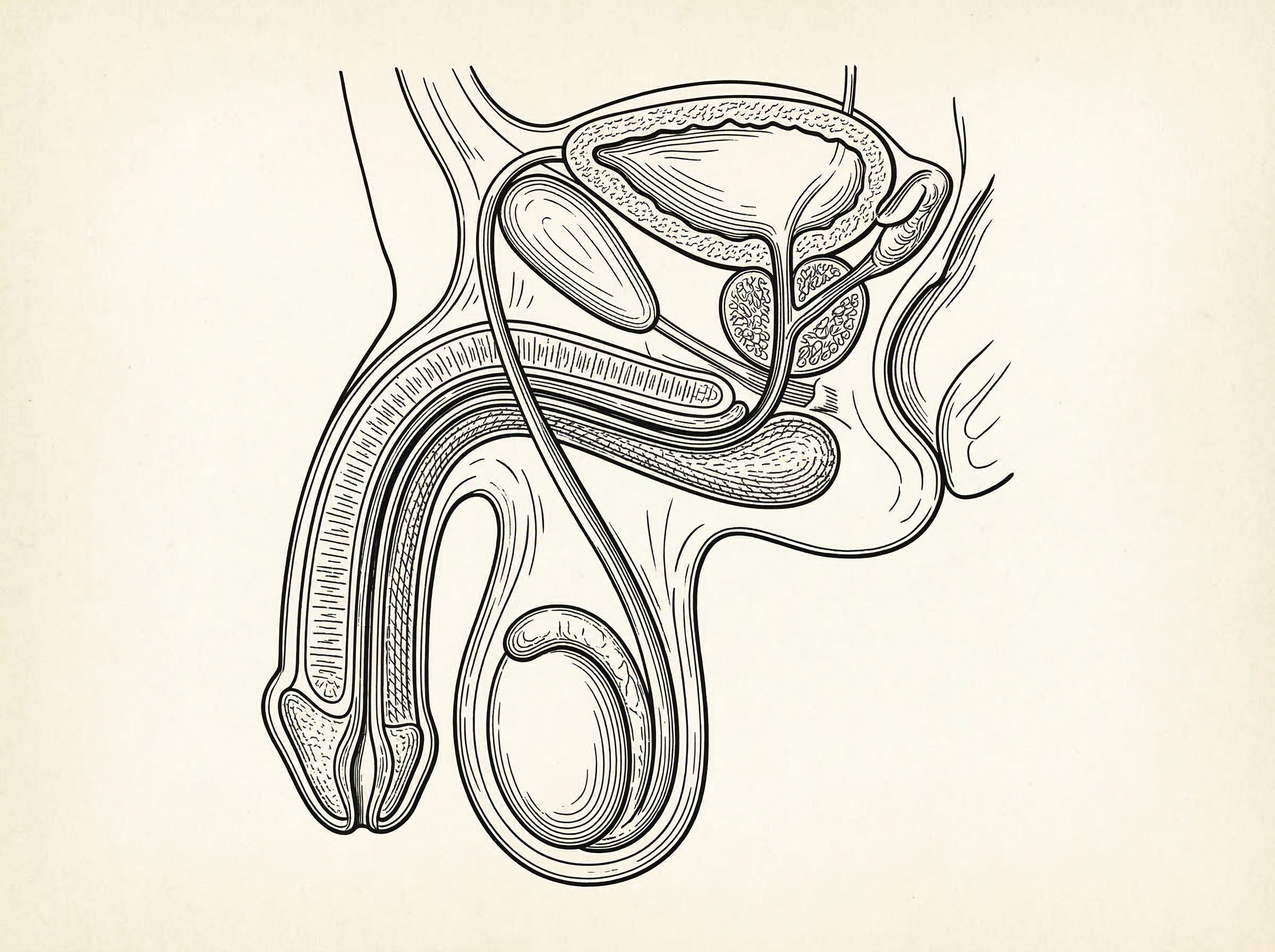
Performance isn't about "muscle" in the traditional sense; there is no skeletal muscle inside the shaft itself. Instead, it is a masterclass in hydraulic engineering. The bulk of the internal structure consists of two cylinders called the corpora cavernosa.
These are sponge-like tissues that, when the brain sends the signal, fill with blood at a pressure significantly higher than the rest of your circulatory system. When these chambers are full, the veins that normally drain blood away are compressed against a tough outer casing, locking the fluid inside. This is why cardiovascular health is directly tied to male performance. If your heart and arteries are clogged or weak, the hydraulic system cannot reach its maximum PSI. Your anatomy is the ultimate "check engine" light for your heart.
3. The Pressure Valve: The Tunica Albuginea
If the corpora cavernosa are the fuel tanks, the tunica albuginea is the steel casing. This is a layer of dense, inelastic connective tissue that surrounds the erectile chambers. It is one of the toughest tissues in the human body.
Its job is to contain the pressure. Because the tunica albuginea does not stretch easily, it forces the blood-filled chambers to become rigid rather than just expanding like a balloon. This rigidity is what allows for the function required in traditional male roles—protection and reproduction. However, this casing can be damaged. Blunt force or extreme "accidents" during physical activity can cause a tear in this tissue. For a man, protecting this structural integrity is as important as protecting his joints or his eyes.
| Component | Primary Function | Critical Factor |
|---|---|---|
| Corpora Cavernosa | Hydraulic rigidity | Blood flow/PSI |
| Tunica Albuginea | Pressure containment | Tissue elasticity |
| Cremaster Muscle | Thermal regulation | Temperature control |
4. The Biological Thermostat: The Cremaster Muscle
The continuation of your lineage depends on a very narrow temperature range. Your testicles are housed outside the body for a specific reason: the production of healthy sperm requires a temperature about two to three degrees cooler than your core body temperature.
To manage this, your body employs the cremaster muscle. This muscle is an involuntary system that raises or lowers the scrotum based on external temperature or perceived threat. If it’s cold, the cremaster pulls the testes closer to the body to soak up heat. If it’s hot, it relaxes to allow for cooling. This is also why many men experience a "retraction" during high-stress situations or physical combat; the body is instinctively moving the most vulnerable part of the anatomy out of harm's way. It is a primitive, effective survival mechanism.
The "cremasteric reflex" is a survival instinct. If you stroke the inner thigh, the cremaster muscle immediately pulls the testicle on that side upward. It’s a built-in defense mechanism to protect the most vulnerable parts of a man during a struggle.
5. The Powerhouse Floor: The Ischiocavernosus
While the shaft itself contains no muscle, the base—the part you can’t see—is surrounded by powerful pelvic floor muscles, specifically the ischiocavernosus and the bulbospongiosus.
These muscles are the real engines of performance. The ischiocavernosus muscle wraps around the internal "crura" (the legs) of the penis and helps maintain the pressure within the hydraulic chambers. A man with a strong pelvic floor has better control and more power. For decades, men have ignored this part of their fitness, leaving it to women. But for the modern man, training these muscles through targeted exercises is the equivalent of strengthening his core. It’s the difference between a shaky foundation and a solid one.
6. The Glans: A Specialized Sensor
The head of the organ, known as the glans, is actually the expanded end of a third chamber called the corpus spongiosum. Unlike the other two chambers, this one remains relatively soft even during peak performance. This is by design; its job is to act as a shock absorber and to ensure the urethra remains open for the passage of fluid.
The glans is packed with thousands of nerve endings, but it also serves a physical purpose. In many ways, the shape of the glans is designed to act as a piston, a product of evolutionary competition. Its structure is optimized for the biological reality of reproduction, ensuring that a man’s genetic material is placed exactly where it needs to go. It is a tool shaped by millions of years of selection.
7. The Prepuce: More Than Just Skin
For those who are uncircumcised, the prepuce (or foreskin) is a complex piece of anatomy. It isn't just "extra skin." It serves as a protective layer for the glans, keeping the tissue supple and sensitive.
In a natural state, the prepuce moves back and forth, reducing friction during activity. This mechanical movement is part of the original design of the male body. While circumcision is a common practice in many cultures for religious or hygiene reasons, the biological fact is that the prepuce is a highly vascularized and innervated part of the anatomy. It acts as a natural lubricant and shield, protecting the most sensitive parts of the man from the elements and abrasive clothing.
8. The Cooling System: The Pampiniform Plexus
We’ve mentioned that the testes need to stay cool, but how does the blood stay cool when it’s coming from the hot core of the body? The answer is the pampiniform plexus.
This is a network of small veins that wrap around the testicular artery. It works like a heat exchanger in a car radiator. The cool blood returning from the scrotum absorbs the heat from the warm arterial blood coming down from the abdomen. By the time the blood reaches the testes, it has been pre-cooled. This is a highly efficient, passive cooling system that works 24/7. When this system fails—often due to a condition called a varicocele (enlarged veins)—the temperature rises, and fertility can drop. A man should be aware of the "plumbing" in this area; any feeling of a "bag of worms" in the scrotum usually means the cooling system is malfunctioning.
9. The Growth Timeline: The Second Puberty
Most men think their anatomy stops changing once they hit twenty. In reality, the male body is in a constant state of flux. While the primary growth happens during the teenage years driven by a surge in testosterone, the anatomy continues to shift as a man ages.
Later in life, as testosterone levels naturally dip, the tissues of the corpora cavernosa can lose some of their elasticity. The skin may change, and the suspensory ligament may relax. However, the biggest change often isn't the organ itself, but the surrounding area. As men gain weight in the midsection, the "pubic fat pad" can begin to bury the base of the organ, making it appear smaller. This is why maintaining a low body fat percentage and high muscle mass is the best way to maintain the "specs" of your anatomy into your 40s, 50s, and beyond.
10. Symmetry and Variation: The Deviated Path
There is a common myth that the ideal male anatomy is perfectly straight. The biological reality is that most men have some degree of curvature. This is usually due to slight differences in the length or elasticity of the tunica albuginea on one side versus the other.
As long as the curve doesn't cause pain or prevent function, it is a normal biological variation. It’s like a thumbprint; every man’s "blueprint" is slightly different. Some curve left, some right, some up. This is rarely a flaw and often just a result of how the tissue developed during puberty. Understanding that variation is the norm helps a man move past the insecurities fueled by unrealistic portrayals in media. Your body is a tool, not a display piece in a museum. Its value lies in what it can do, not in its perfect symmetry.
Anatomy Recon: Common Questions
Taking Command of Your Health
Knowing these facts is about more than just trivia. It’s about ownership. When you understand that your performance is tied to your heart health, you take your cardio more seriously. When you understand that your cooling system is vital for your legacy, you stop wearing restrictive, overheating gear.
The male body is built for action and endurance. It is a rugged, pressurized system designed to withstand the rigors of life and the demands of reproduction. Treat it with the respect a high-performance machine deserves. Don't wait for a breakdown to start paying attention to the mechanics.
The next time you think about your physical health, don't just focus on your biceps or your bench press. Consider the complex, hidden systems that define your manhood. A man who knows his anatomy is a man who can maintain it, protect it, and utilize it to its full potential.
Quick-Start: Maintenance Manual
- Prioritize cardio for hydraulic health.
- Wear loose clothing to support the cooling system.
- Train your pelvic floor (Kegels).
- Ignore the "bag of worms" feeling (Varicocele).
- Smoke (it damages the tunica albuginea's elasticity).
- Risk "enhancement" surgeries that cut ligaments.
Disclaimer: The articles and information provided by Genital Size are for informational and educational purposes only. This content is not intended to be a substitute for professional medical advice, diagnosis, or treatment. Always seek the advice of your physician or another qualified health provider with any questions you may have regarding a medical condition.